When a supplier says "food-grade stainless steel," do not treat the phrase as proof. For a buyer, food-grade stainless steel should be verified through a chain of evidence: the right alloy for the food and cleaning environment, material traceability, a cleanable surface condition, suitable fabrication, and the food-contact requirements of the destination market. A 304 or 316L label can be part of the answer, but it is not the whole answer. Food-contact suitability depends on how the material will be used, cleaned, fabricated, and documented.
That distinction matters because many stainless steel complaints begin with a small wording problem on the purchase order. The buyer asked for "food grade." The supplier shipped a material grade. The finished equipment later had weld discoloration, rough grinding marks, unverified surface treatment, or no document trail for the market where the equipment was installed.
This article gives buyers a practical way to separate a useful food-contact stainless steel offer from a label that is too vague to release an order.
The Problem With the Phrase "Food-Grade Stainless"
"Food-grade stainless steel" sounds precise, but it can mean several different things:
- the steel is a common food-contact alloy, such as 304 stainless steel or 316L stainless steel;
- the material has a surface that can be cleaned and maintained;
- the finished part is suitable for food-contact service;
- the equipment follows a route such as NSF, 3-A, EU food-contact requirements, or GB food-contact requirements;
- the supplier is simply using a commercial phrase without supporting documents.
For buyers, the safest interpretation is this: a food-grade claim is not complete until it names what is being proven.
U.S. food manufacturing rules such as 21 CFR 117.40 focus on equipment and utensils being cleanable, corrosion resistant when in contact with food, nontoxic, and able to withstand the intended use and cleaning procedures. That does not mean any material sold as "304 food grade" automatically proves the finished equipment is suitable.
EU food-contact rules also focus on the finished material or article not releasing constituents into food in a way that could endanger health or unacceptably change the food. China's GB 4806.9-2023 applies to metal materials and products for food contact. In each case, the practical question is not only "What grade is it?" but "Can this material, after fabrication, support the actual food-contact use?"
A Buyer Should Ask: Certified for What?
Before accepting a food-grade claim, ask the supplier to define the scope.
| Supplier claim |
What it may mean |
What the buyer should ask next |
| "Food-grade 304" |
The alloy is 304, a common food-contact stainless steel |
Can you provide the MTC, heat number, ordered standard, finish condition, and intended food-contact use? |
| "Food-grade 316L" |
The alloy has more corrosion margin than 304 in many chloride or acidic services |
Is 316L required because of brine, salt, cleaning chemicals, temperature, or customer specification? |
| "NSF material" |
It may refer to material requirements or a listed component |
Which NSF standard or listing applies, and is it for the material, component, or finished equipment? |
| "3-A stainless" |
It may refer to sanitary equipment design expectations |
Is the finished equipment authorized to use the 3-A Symbol, or is only the raw material being described? |
| "GB 4806.9 compliant" |
It may relate to China's food-contact metal material standard |
What test report, declaration, material identity, and intended use support the statement? |
| "FDA approved stainless" |
Often imprecise wording |
Which food-contact rule or customer requirement is being referenced? |
The strongest suppliers do not hide behind the label. They explain the limit of their proof. A mill or processor can usually support alloy, heat traceability, thickness, finish, and ordered surface requirements. A fabricator or equipment maker must support welds, geometry, drainage, final cleanability, and finished-equipment compliance.
The Evidence Chain Buyers Should Build
A food-contact stainless steel order should be reviewed as a chain, not as a single certificate.
1. Alloy and heat traceability
Start with the MTC. For stainless steel sheet, coil, tube, or bar, the MTC should connect the shipment to the heat number, grade, chemical composition, mechanical properties where required, and the ordered standard. If the order says 304 or 316L, the document should support that identity.
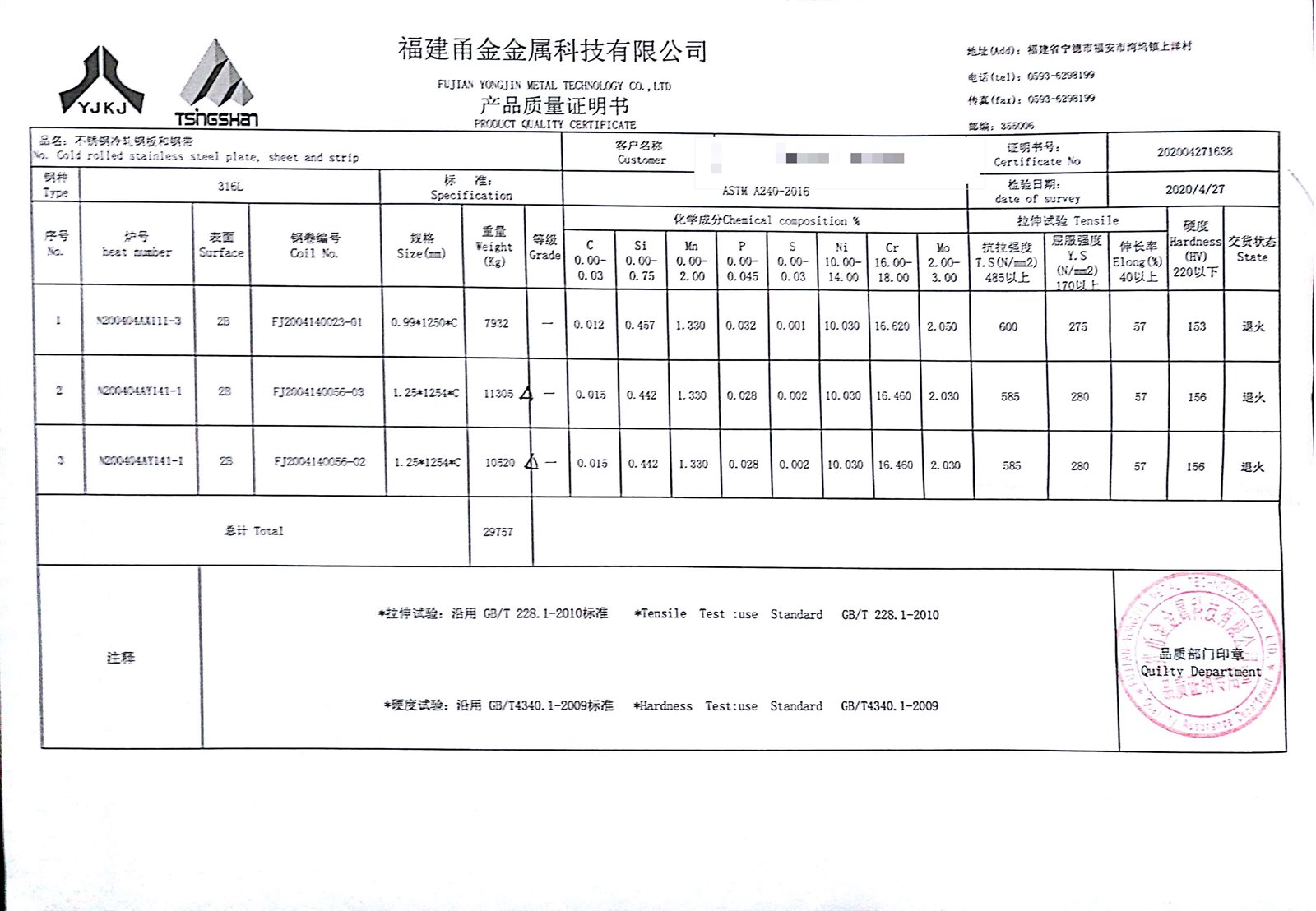
This is where vague wording becomes risky. "Food-grade stainless with certificate" does not tell the buyer whether the heat number, material grade, delivery standard, and shipment markings can be matched during inspection.
2. Corrosion environment
The right grade depends on the food and cleaning environment. 304 is widely used in food and beverage equipment when corrosion exposure is moderate. 316L becomes more defensible when the surface regularly sees brine, chloride cleaners, acidic products, wet storage, or coastal air.
For simple dry-contact or moderate kitchen equipment, 304 stainless steel may be the practical baseline. For chloride-heavy food processing, wet service, or sanitary routes, 316L stainless steel can provide more corrosion margin.
3. Surface condition and cleanability
Food-contact surfaces need to be cleanable after real fabrication, not just attractive on arrival. Surface roughness, weld clean-up, passivation, seams, pits, folds, and crevices all matter.
A finish name such as 2B stainless steel finish, BA, or No.4 helps describe the starting surface, but it does not replace a clear cleanability requirement when hygiene risk is high. If the application needs a measured surface target, the buyer should state where the measurement is taken and who is responsible after fabrication.
4. Fabrication after the material leaves the mill
Cutting, welding, bending, polishing, and assembly can change the risk profile. A clean MTC does not prove that a weld was cleaned, a corner is drainable, or a ground surface is free from embedded contamination.
If the order involves stainless steel tube and pipe, tanks, conveyors, hoppers, food-contact panels, or kitchen equipment, ask what happens after the raw material is processed. The buyer should confirm weld treatment, surface repair, passivation where required, and final inspection photos.
5. Destination-market requirements
The compliance route depends on where the product is used or sold. A U.S. buyer may care about food manufacturing equipment rules and NSF food equipment routes. A dairy or hygienic process buyer may ask for a 3-A route. A China-market food-contact article may need GB 4806.9 attention. An EU buyer may request food-contact declarations under the EU framework.
The same stainless steel material can be used in different finished articles. The required evidence changes with the article, the customer specification, and the destination market.
What Suppliers Often Skip
Weak offers usually skip one of five things.
First, they sell the grade as the certificate. "304 food grade" sounds reassuring, but the MTC only proves material identity. It does not prove final hygiene design.
Second, they avoid the cleaning environment. Chloride sanitizer, salty food, acid, heat, and wet storage can change the grade decision. A food-contact claim without use conditions is incomplete.
Third, they do not separate mill evidence from equipment evidence. A coil supplier cannot honestly certify the buyer's finished machine unless the supplier controls the design and fabrication.
Fourth, they ignore surface changes after fabrication. The incoming surface may be clean, but welding, grinding, or poor handling can create the actual risk.
Fifth, they use certification language loosely. NSF, 3-A, FDA, EU, and GB references are not interchangeable. Each route has its own scope and document logic.
A Practical Release Checklist
Before releasing a food-contact stainless steel order, ask for the following:
| Release item |
Why it matters |
Minimum buyer action |
| Grade and standard |
Confirms material identity |
Specify 304, 304L, 316L, or another grade clearly on the PO |
| MTC with heat number |
Supports traceability |
Match heat number to coil, sheet, tube, or bundle marking |
| Surface requirement |
Supports cleanability |
Specify 2B, polished, No.4, or Ra target where needed |
| Use environment |
Prevents wrong grade selection |
State brine, chloride cleaner, acidic food, wet service, or coastal exposure |
| Fabrication controls |
Protects final surface condition |
Confirm weld clean-up, passivation, and inspection photos |
| Market rule or customer standard |
Prevents document mismatch |
Name NSF, 3-A, EU, GB 4806.9, or customer specification only when relevant |
| Final equipment responsibility |
Avoids false certification claims |
Define whether the mill, processor, fabricator, or equipment maker owns each document |
Better PO Wording
Avoid this:
Food-grade stainless steel, good quality, with certificate.
Use wording that can be verified:
304 stainless steel sheet for food-contact equipment panels, 2B finish, MTC required, heat traceability maintained, surface protected for fabrication, no oil residue on food-contact surface.
For chloride-heavy or wet service:
316L stainless steel sanitary tube for food and beverage process line, MTC required, inner surface finish or Ra target stated, weld/passivation record to be provided after fabrication, final cleaning procedure confirmed by equipment maker.
For a China-market food-contact article:
Stainless steel material for food-contact article, grade and heat traceability required, supplier to support GB 4806.9-related document review according to final product use and customer test plan.
Final Buyer Takeaway
Food-grade stainless steel is not a magic material label. It is a verification process. The buyer should confirm the alloy, the surface, the fabrication route, the cleaning environment, and the destination-market document route before treating a shipment as ready for food-contact use.
If the application is general food and beverage stainless steel applications, 304 may be the right starting point. If the surface will face brine, chloride cleaners, acidic foods, wet service, or coastal air, 316L may be the safer specification. For tubes, hygienic fabrication, or process equipment, review sanitary tube requirements early instead of treating the tube as a normal commodity pipe.
Before releasing the order, ask for five things in writing: the MTC, heat traceability, surface requirement, fabrication responsibility, and destination-market document route. The safest order is not the one with the biggest food-grade label. It is the one with the clearest proof.