201 can replace 304 only in a narrow window: dry indoor decoration, low corrosion demand, easy replacement, and no hidden chloride exposure. In that window the saving is real. Outside it, the saving often reappears later as staining, complaint handling, rework, or replacement.
This is why the first question should not be "how much cheaper is 201?" The first question is "where will the surface live after installation?" A 2B or No.4 sample can make 201 and 304 look almost identical. The environment separates them.
What Actually Changes Between 201 and 304?
201 is not fake stainless. It is a recognized austenitic grade. The problem is substitution without respecting the smaller corrosion margin.
| Decision point |
201 |
304 |
Practical meaning |
| Nickel |
3.5–5.5% |
8.0–11.0% |
201 is cheaper because it uses much less nickel |
| Manganese |
5.5–7.5% |
≤2.00% |
Mn helps replace nickel structurally, not corrosion-wise |
| Chromium |
16.0–18.0% |
18.0–20.0% |
304 starts with a stronger passive-film base |
| Carbon |
≤0.15% |
≤0.08% |
201 allows more carbon; check welding and forming demands |
| Day-one appearance |
Similar |
Similar |
Visual inspection cannot prove the grade |
201 also has higher minimum yield and tensile strength than 304. That sounds attractive, but it rarely decides decorative sheet orders. In panels, trims, and cladding, the governing issues are surface appearance, corrosion margin, flatness, and consistency after fabrication.
Why Does the Corrosion Gap Matter?
Neither 201 nor 304 contains molybdenum, so chloride resistance mostly comes from chromium and nitrogen. A typical 201 heat sits around PRE 16–17. A typical 304 heat sits around PRE 19. That gap is not dramatic on paper, but it matters when humidity and chloride are allowed to concentrate on the surface.
| Service condition |
201 decision |
304 decision |
| Dry indoor trim |
Acceptable |
Also acceptable, higher margin |
| Indoor furniture, no chemical cleaning |
Acceptable if grade is disclosed |
Safer default |
| Outdoor inland atmosphere |
Marginal |
Usually acceptable with maintenance |
| Coastal air, splash, or monsoon humidity |
Not recommended |
Borderline; often move to 316L |
| Food contact or chlorinated cleaning |
Not recommended |
304 minimum, 316L when chloride/acidity rises |
The early failure mode is usually not structural collapse. It is visible: tea-staining around edges, fingerprints that will not wipe clean, brown marks at screw holes, and pitting in recessed areas. For a decorative surface, visible degradation is already a failure.
Where 201 Works Well
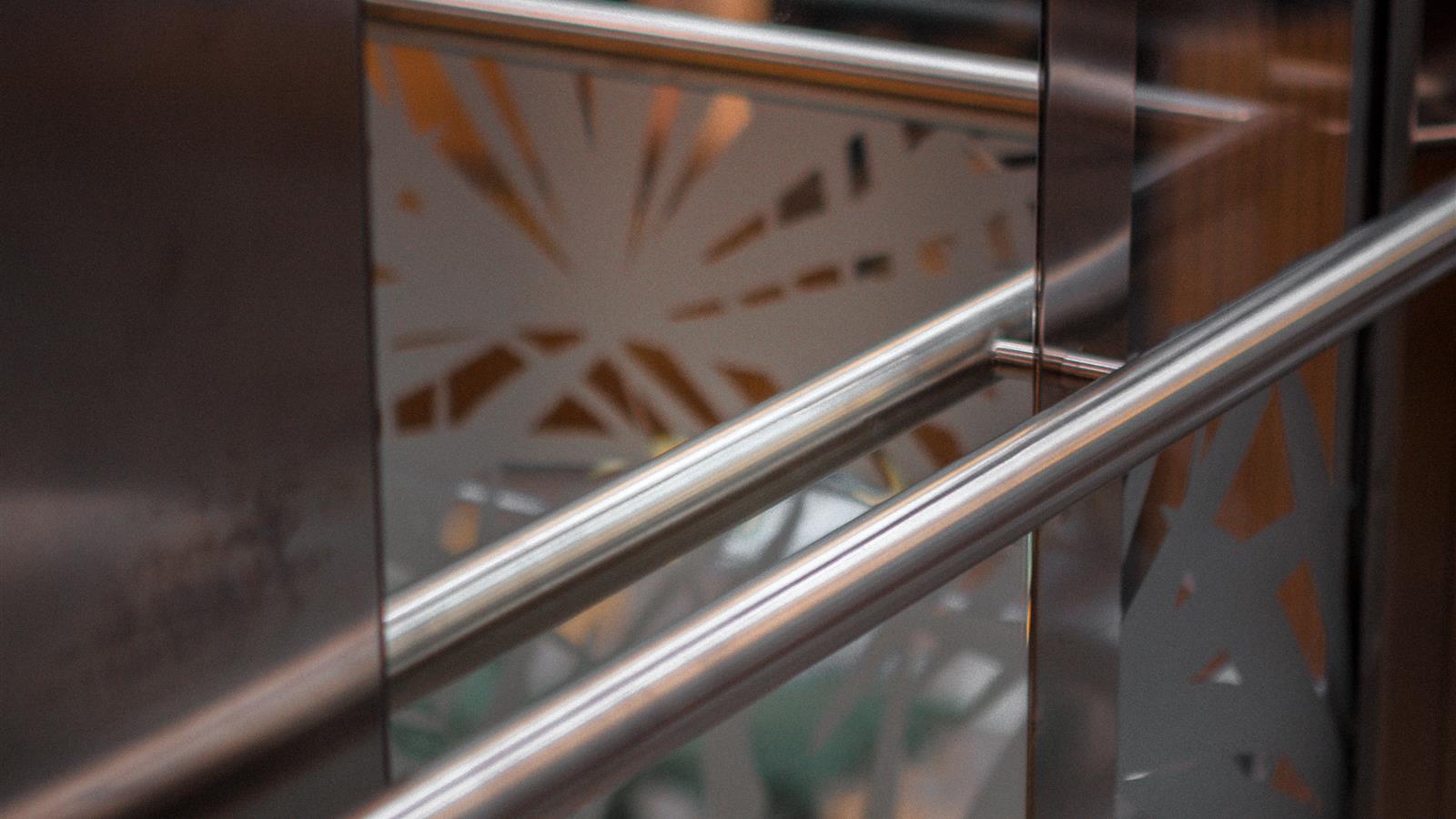
201 has a real place in indoor decorative work. Elevator interior panels, lobby wall cladding, dry retail fixtures, column covers, and low-risk furniture parts can all be rational 201 applications when the buyer understands the service limit.
The best 201 projects share four conditions:
- The surface stays dry and indoors.
- Cleaning is mild and not chloride-based.
- The part is decorative rather than hygienic or structural-critical.
- Replacement or complaint handling would be manageable if the surface ages poorly.
This is also why 201 often appears with No.4 brushed, hairline, and some indoor mirror work. The finish can be attractive. The warning is not about looks. It is about exposure.
Where 201 Becomes False Economy
The risky applications are predictable. Once the part moves outdoors, near the sea, into food service, or into uncertain maintenance, the discount becomes too fragile.
| Application |
Safer floor |
Reason |
| Food equipment or washdown areas |
304 / 316L |
Cleaners and food acids punish 201 early |
| Outdoor railings and facade panels |
304 minimum, often 316L |
Humidity and deposits concentrate at joints |
| Coastal decorative work |
316L |
201 has too little chloride margin |
| Export orders with written grade requirement |
Match the PO |
201 is not a compliant substitute for specified 304 |
The hard part commercially is that the wrong substitution can pass the first inspection. It can also pass fabrication. The problem appears after rain cycles, cleaning chemistry, or salt-laden dust has enough time to work.
How Much Do You Save?
The discount moves with nickel. When nickel rises, 201 becomes tempting because it carries much less of it. On commodity cold-rolled coil, 201 commonly lands 15–25% below 304, with the exact spread changing by mill, gauge, width, and market timing.
That saving survives when the application is truly indoor and dry. It fails when the surface needs 304-level corrosion resistance. A single replacement, claim, or site visit can erase the alloy saving many times over.
For purchasing teams, the clean rule is this: use 201 as a declared cost-down material, not as a quiet substitute. If the drawing, customer contract, or country standard asks for 304, quote 304 unless the buyer formally approves the change.
How Do I Tell 201 from 304?
You cannot reliably identify 201 and 304 by looking at a 2B, BA, No.4, or hairline surface. You need chemistry evidence.
| Check |
What it tells you |
Limit |
| Mill Test Certificate |
Heat chemistry, grade, standard, heat number |
Must match physical marking and PO |
| Handheld XRF / PMI |
Ni and Mn content in seconds |
Best field check for suspicious substitutions |
| Magnet test |
May flag ferritic material |
Cannot separate annealed 201 from annealed 304 |
For 304, expect nickel around 8–10% and manganese below 2%. For 201, expect nickel around 3–5% and manganese around 5–7%. If the material is commercially important or unusually cheap, use PMI before fabrication, not after complaint.
Substitution Shortcut
Use 201 only when the part is dry, indoor, decorative, and honestly easy to replace. Use 304 when humidity, outdoor exposure, food contact, or customer-visible service life matters. Move to 316L when the environment includes coastal air, frequent chloride cleaning, acidic food chemistry, or more serious corrosion demand.
If the customer asked for 304, do not treat 201 as a visual equivalent. It may look equivalent on arrival. It is not equivalent in service.
How We Quote It
We stock and quote 201 mainly for indoor decorative buyers who already understand the boundary. When a 201 enquiry mentions outdoor use, coastal location, food contact, or uncertain cleaning, we usually quote 304 instead and explain the reason before the order is released.
That approach loses some low-price comparisons. It also prevents the worst kind of stainless problem: a surface that looked good in the warehouse and became the buyer's problem only after installation.