From August 10 to August 14, the stainless steel market was generally downward. Early in the week, the East China coast was disrupted by rainstorms, restricting logistics shipments. Sluggish demand dragged down both futures and spot prices. On Thursday and Friday, the market weakened further: Tsingshan lowered the 300-series price limits by US$75/MT. The market went even gloomier.
The sharp drop in stainless steel spot prices compressed steel mill profits. Stainless steel mills had to put pressure on the raw materials side, reducing costs from suppliers of ferronickel and ferrochromium.
In the short term, production costs will still protect stainless steel prices from collapsing. However, weak demand during the off-season has kept the overall trend fatigued. Going forward, once cost support from nickel and chrome is lost, stainless steel spot prices will probably decline.
Stainless Steel Futures and Spot Prices Both Decline
Last week, both stainless steel and Shanghai nickel futures generally fluctuated downward. As of the close on Friday, August 14, the main stainless steel contract closed at US$2,113/MT, with a cumulative weekly drop of US$82/MT, a decrease of 3.75%. The decline in futures was greater than in the spot market, widening the futures-spot basis to US$75.5/MT. The main Shanghai nickel contract closed at US$19,017/MT, a weekly drop of 2.62%.
Stainless Steel 304 Price Decline Expands to around US$75/MT
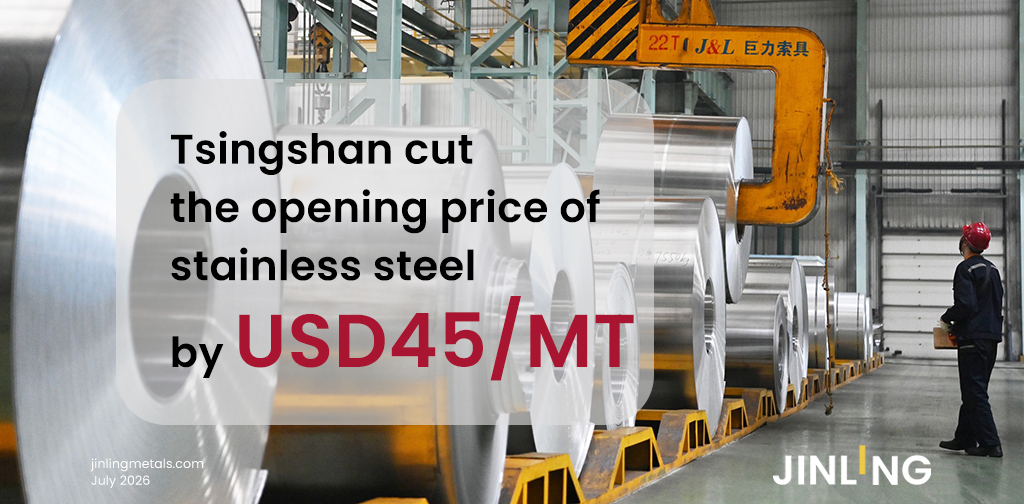
Stainless steel 304 prices fell under pressure, with the decline expanding to a range of US$22-US$75/MT. Among them, Yongjin prices fell by about US$75/MT, while the decline for TISCO origins was relatively smaller. Tsingshan Group has not yet issued the cold-rolled stainless steel 304 futures plate price, but its price limit policy has been cumulatively lowered by US$45-US$74/MT.
In the Wuxi market, for cold-rolled prices, the mainstream transaction quotation for 4-foot private cold-rolled stainless steel 304 from origins like Liyang and Delong was US$2,255/MT. Yongjin 4-foot price was US$2,255/MT, and Hongwang Indonesia was US$2,255/MT. TISCO 4-foot cold-rolled stainless steel was US$2,405/MT, and ZPSS 4-foot cold-rolled coil price was US$2,390/MT.
Regarding hot-rolled prices, the mainstream private 5-foot hot-rolled SS304 coil price was US$2,210/MT. TISCO 5-foot hot-rolled stainless steel was US$2,285/MT. In the Foshan market, private 4-foot cold-rolled stainless steel 304 was US$2,245/MT on a gross basis, and the 304 hot-rolled coil price was US$2,210/MT.
Stainless Steel 316L Mainstream Prices Drop US$45/MT
Last week, stainless steel 316L spot prices trended downward, dropping by US$45/MT. In August, the supply of SS316L increased significantly, with growth in hot-rolled resources particularly prominent. Under the heavy loads of stock, coupled with continuous pressure on the futures market, Tsingshan lowered the stainless steel 316L agent price by US$45/MT, driving spot market prices to decline in tandem.
In terms of pricing, Yongjin's cold-rolled stainless steel 316L was US$4,555/MT, and Tsingshan hot-rolled stainless steel 316L was US$4,430/MT. The mainstream quotation for TISCO and ZPSS cold-rolled 316L was US$4,640/MT, ZSESS hot-rolled stainless steel 316L was US$4,425/MT, and TISCO hot-rolled coil price was US$4,515/MT.
Stainless Steel 201 Prices Drop US$7-US$15/MT
Last week, the overall 201 stainless steel market experienced a small decline. Earlier, leading steel mills jointly issued a price limit policy, stipulating that the minimum spot sales price in the market should not be lower than US$1,270/MT.
Agents in the spot market are basically maintaining the price limit regulations, with cold-rolled SS201 J2/J5/D4 prices at US$1,270/MT on a gross basis. The hot-rolled SS201 dropped to US$1,195/MT. Last week, August plate prices from Tsingshan and Beigang New Materials remained flat, with 201 cold-rolled J2/J5/D4 remaining at around US$1,285/MT on a gross basis.
Stainless Steel 400 Series Prices Remain Generally Stable
In general, the stainless steel 400 series remained stable last week. Steel mills maintained their price-supporting strategies. Constrained by high ordering costs, spot traders were unwilling to decrease prices. However, large inventory forces steel mills to get ready for the future decline in price: mills lowered their August procurement price for high-carbon ferrochrome by US$30/50 reference ton, driving the stainless steel 400 series' August production cost slightly lower. Hidden price cuts have been noticed in the market, with effective transactions mostly concentrated in the low-price range.
In terms of pricing, for the TISCO series, cold-rolled stainless steel 430 is quoted at US$1,255/MT, and cold-rolled stainless steel 439 is quoted at US$1,560/MT.
Raw Material: Indonesia's Nickel Ore Consumption from January to July Reached 53%-55% of Annual Quota
Indonesia's nickel mining quota policy remains the largest variable to the stainless steel market. Previously, disturbed by rumors of increments from WBN, ShFE nickel dropped weakly, because the supply of nickel was likely to shift from tight to loose. However, the Indonesian Nickel Miners Association later made an official statement, clarifying that the nickel ore mining quota remains unchanged at 260-270 million tons, which is largely reduced compared to the 379 million tons in 2025.
Until July, nickel ore mining had already used 53%-55% of the annual quota. In the second half of the year, the nickel ore supply will probably fall short. The raw material cost support for ferronickel smelters remains solid, and spot prices remain firm.
Sea Freight: China to South American Route Freight Rates Rise 14.1%
On August 14, the Shanghai Containerized Freight Index was 3,355.24 points, up 2.4% from the previous period.
European route: On August 14, the market freight rate, including ocean freight and ocean surcharges, from Shanghai Port to European base ports was US$2,945/TEU, down 0.6% from the previous period.
Mediterranean route: The market trend was consistent with the European route, with market freight rates continuing to fall. On August 14, the market freight rate from Shanghai Port to Mediterranean base ports was US$3,929/TEU, down 2.9% from the previous period.
North American route: Last week, shipping demand remained stable, supply-demand fundamentals were solid, and spot market booking prices rose slightly. On August 14, freight rates from Shanghai Port to US West Coast and US East Coast base ports were US$6,714/FEU and US$9,568/FEU, up 3.5% and 3.0% respectively from the previous period.
Persian Gulf route: The situation in the Middle East remains tense, and the effective restoration of direct route distances is still nowhere in sight; the freight rate index continued to rise last week. On August 14, the freight rate from Shanghai Port to Persian Gulf base ports was US$5,422/TEU, up 3.1% from the previous period.
Australia-New Zealand route: The recovery in shipping demand pushed market freight rates to continue upward. On August 14, the freight rate from Shanghai Port to Australia-New Zealand base ports was US$2,267/TEU, up 2.4% from the previous period.
South American route: Shipping demand was stable with a positive outlook, supply-demand relations were good, and spot market freight rates maintained an upward trend. On August 14, the freight rate from Shanghai Port to South American base ports was US$7,119/TEU, up 14.1% from the previous period.
Port Congestion and Sailing Delays Consume Effective Shipping Capacity
According to the Global Schedule Reliability Report released by maritime consulting firm Sea-Intelligence on July 27, 2026, global liner schedule reliability fell to 62.6% in June, a further decline of 1.9 percentage points from May's 64.5%, and 4.7 percentage points lower than the same period in 2025. This means nearly 40% of global arriving vessels cannot reach ports according to their original schedules.
The severity of the delays is equally concerning. Data shows that the average delay for late vessels has reached 5.31 days, significantly higher than the pre-pandemic level of about 3 to 4 days. Sea-Intelligence further estimated that about 5% of global container ship capacity, equivalent to roughly 1.7 million TEU, has been absorbed by port and related delays. This scale is almost equivalent to the entire fleet of Evergreen Marine. After deducting the historical normal delay baseline of about 2.2%, the additional effective capacity consumed still reaches about 1.06 million TEU, roughly equivalent to the total capacity of HMM.
Meanwhile, the latest industry advisory issued by DHL Global Forwarding shows that containers piled up at global ports have exceeded 3.7 million TEU.
Climate Is an Important Reason for Consumed Capacity
High temperatures and droughts brought by extreme weather have caused the Panama Canal to tighten traffic restrictions again. The Panama Canal Authority announced on August 5 that, affected by continuously dropping water levels, it will tighten the maximum allowable draft for Neopanamax locks to 48 feet starting August 26, and further reduce it to 47.5 feet starting September 3, with these restrictions continuing until further notice. This is another tightening following the reduction to 49 feet on July 24. For container ships, every 1-foot reduction in draft means being forced to reduce cargo loads by hundreds of containers.
European inland transportation has also experienced capacity declines and port congestion due to continuously dropping water levels. On August 12, the reading at the Kaub water level station on the middle Rhine River in Germany fell to a historic low of 12 centimeters.
In China, typhoons have continuously struck the southeast coast, causing port shutdowns. According to a report released by Linerlytica on August 11, affected by typhoons, over 2.4 million TEU of container ship capacity in North Asia experienced delays. Ningbo and Shanghai were the most heavily affected ports, and it is expected to take weeks to gradually clear the backlog of vessels.
As of August 17, a week after the typhoon impacts ended, the average waiting time for vessels at Shanghai Port still exceeded 4 days. Maersk has continuously issued blank sailing notices, canceling originally scheduled calls at Shanghai Port for multiple voyages.
Additionally, geopolitical risks have also driven up transportation costs. Since late July, Houthi forces have attacked a total of 8 Saudi oil tankers and intercepted and forced 29 Saudi oil tankers to turn back in the Red Sea and Arabian Sea.