Stainless steel futures prices operated weakly last week. Early in the week, the most-traded stainless steel futures contract continued to probe the bottom, then rebounded slightly near the end of the week. Trading volume dropped compared with the previous week, while open interest increased. Market prices diverged at low levels, but overall performance remained cautious.
The main stainless steel futures contract closed at US$2,085/MT, with a weekly drop of 1.18% and an intra-week low of US$2,062/MT.
In the spot market, stainless steel prices fell by about US$23/MT. During the week, macro pressure and water shortage concerns in Indonesia weighed on bulk commodities early in the week. China has entered "Golden September," normally a peak season, but downstream release remained limited. Buyers mainly maintained rigid-demand restocking, with weak willingness for proactive inventory building.

The latest market roundup video covered this topic: watch the stainless steel market roundup.
Steel mill production schedules have been adjusted downward. As the market enters the traditional peak season, stainless steel fundamentals will mainly depend on demand recovery, while price fluctuations are likely to remain relatively high.
In summary, raw material prices have loosened, September production schedules have been revised downward, and social inventories have seen clear destocking, reducing future supply pressure. Downstream consumption is still dominated by rigid-demand restocking. Going forward, buyers should continue watching raw material prices, steel mill production plans, downstream demand follow-up, and policy progress.
Stainless Steel 300 Series: Spot Prices Weakly Probe Lower, Specification Shortages Continue
Last week, stainless steel board prices continued to operate weakly, and 304 cold-rolled and hot-rolled spot prices fluctuated downward. As of Friday, September 4, the mainstream base price for 4-foot cold-rolled stainless steel 304 in Wuxi was reported at US$2,215/MT, and the private hot-rolled price was reported at US$2,185/MT.
Early in the week, macro bearishness and rising geopolitical risks caused the market to open low and move lower, while traders' quotations probed slightly downward. Stainless steel 300-series inventory in Wuxi decreased last week, and some cold-rolled 5-foot and 4-foot specifications have already fallen short.
Stainless Steel 200 Series: Spot Operates Weakly, Low-Level Restocking Emerges
Last week, stainless steel 201 spot prices in Wuxi operated weakly. As of Friday, the mainstream base price for cold-rolled 201 J1 in Wuxi was around US$1,395/MT, the mainstream base price for cold-rolled J2 was around US$1,265/MT, and 5-foot hot-rolled 201 J1 was around US$1,325/MT.
Early in the week, agents took the lead in lowering quotations, and some resources continued to fall, once touching around US$1,250/MT. Purchasing willingness strengthened at low levels, helping cold-rolled inventory destock.
Stainless Steel 400 Series: Prices Operate Weakly and Stably, Both Inventories Destock
Last week, stainless steel 430 market prices remained weak. As of Friday, cold-rolled stainless steel 430 in Wuxi was quoted at US$1,285/MT, and hot-rolled stainless steel 430 was quoted at US$1,165/MT, both flat compared with the previous week.
Market fluctuations temporarily affected trading confidence during the week, and traders yielded profit to ship goods and ease inventory pressure. Later in the week, market sentiment warmed up, and transactions for low-priced resources improved.
Stainless Steel Inventory and Production Scheduling
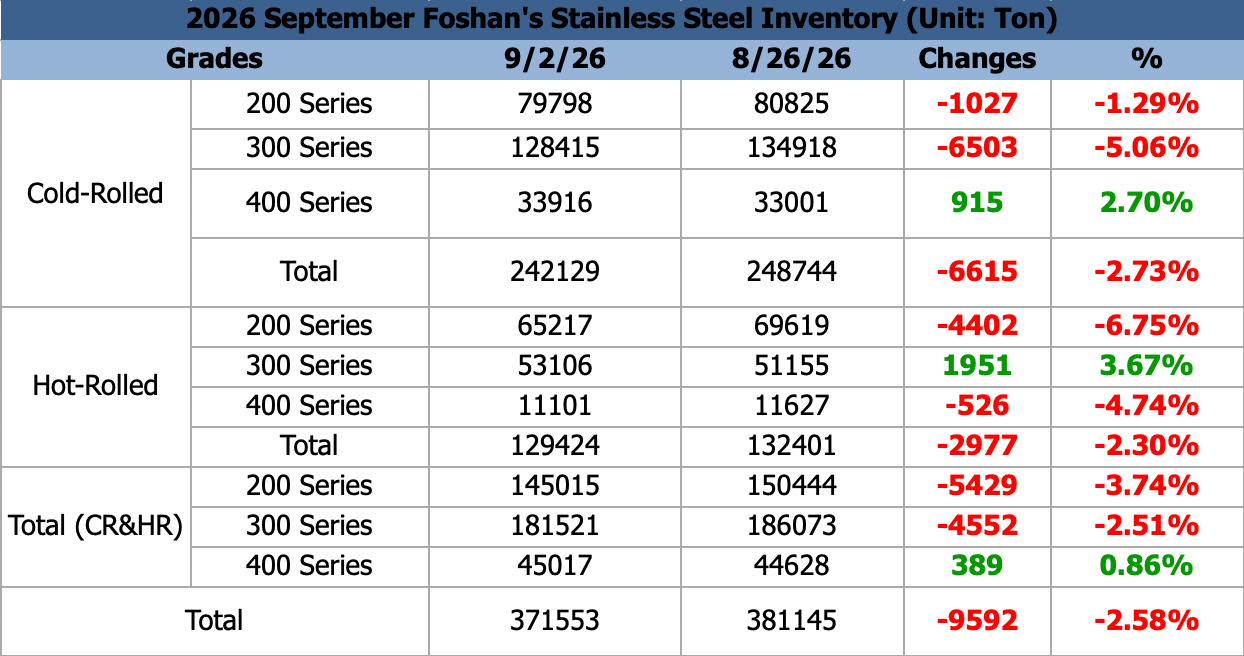
According to market statistics, from August 30 to September 4, the total sample inventory in Foshan was 371,600 tons, down 9,600 tons from the previous week, a decrease of 2.52%.
- Stainless steel 200-series inventory decreased to 145,000 tons, down 5,400 tons from the previous week, a decrease of 3.61%.
- Stainless steel 300-series inventory decreased to 181,500 tons, down 4,600 tons from the previous week, a decrease of 2.45%.
- Stainless steel 400-series inventory increased to 45,000 tons, up 400 tons from the previous week, an increase of 0.87%.
Stainless Steel COO Indonesia Continues to Decrease in Price
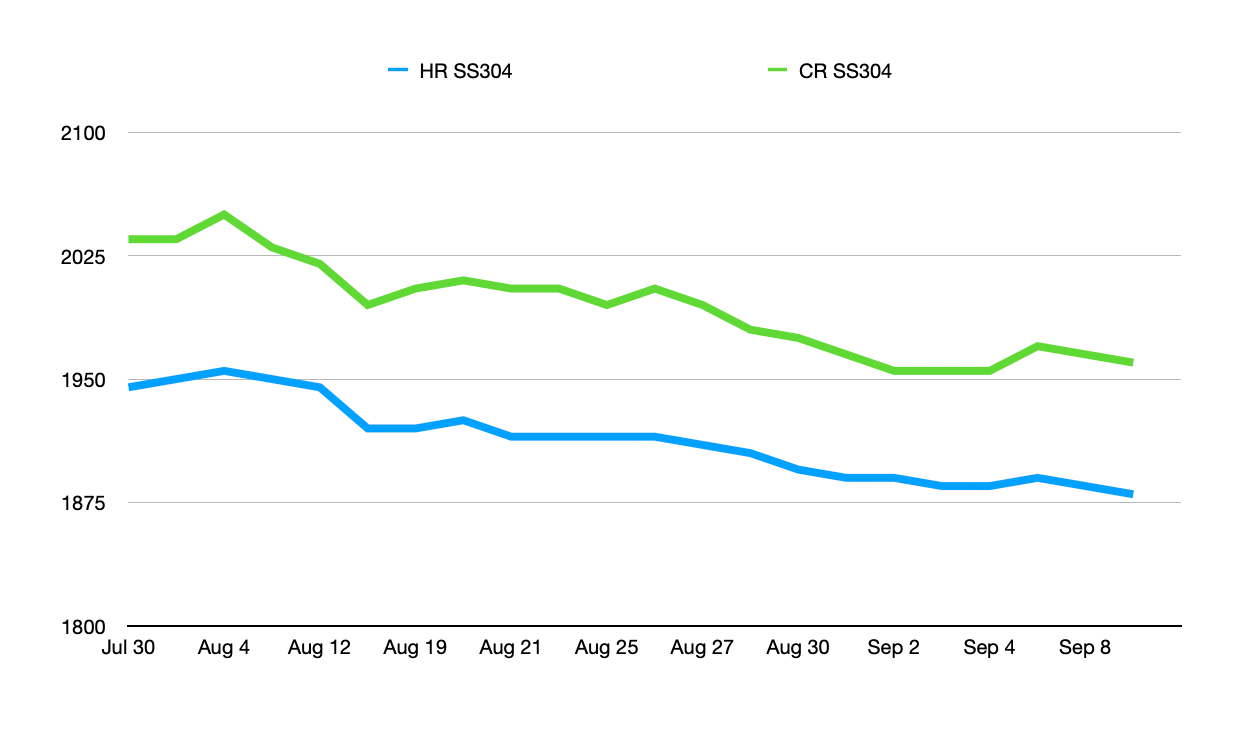
The situation in Indonesia's smelting industry has been weak since June. In August, the base price of hot-rolled stainless steel 304 decreased by US$50/MT, and cold-rolled material dropped by US$60/MT. In June and July, the material fell by US$60/MT and US$30/MT, respectively.
There was a small rise this month, but prices soon returned to a downward path. Steel mills tried to support prices, but by September 9, hot-rolled and cold-rolled stainless steel had fallen by US$10/MT and US$5/MT, respectively.
China's Stainless Steel Cold-Rolled Production Scheduling Rises Slightly in September
According to research, in August 2026, total cold-rolled output from 41 domestic stainless steel plants reached 1.4431 million tons, up 72,500 tons month-on-month, or 5.29%, and down 2.68% year-on-year. Steel mill capacity utilization was 71%, up 3.6 percentage points month-on-month.
- Stainless steel 200-series output was 437,200 tons, up 8,200 tons month-on-month, or 1.91%, and down 1.26% year-on-year.
- Stainless steel 300-series output was 737,400 tons, up 52,500 tons month-on-month, or 7.67%, and down 5.93% year-on-year.
- Stainless steel 400-series output was 268,500 tons, up 11,800 tons month-on-month, or 4.6%, and up 4.8% year-on-year.
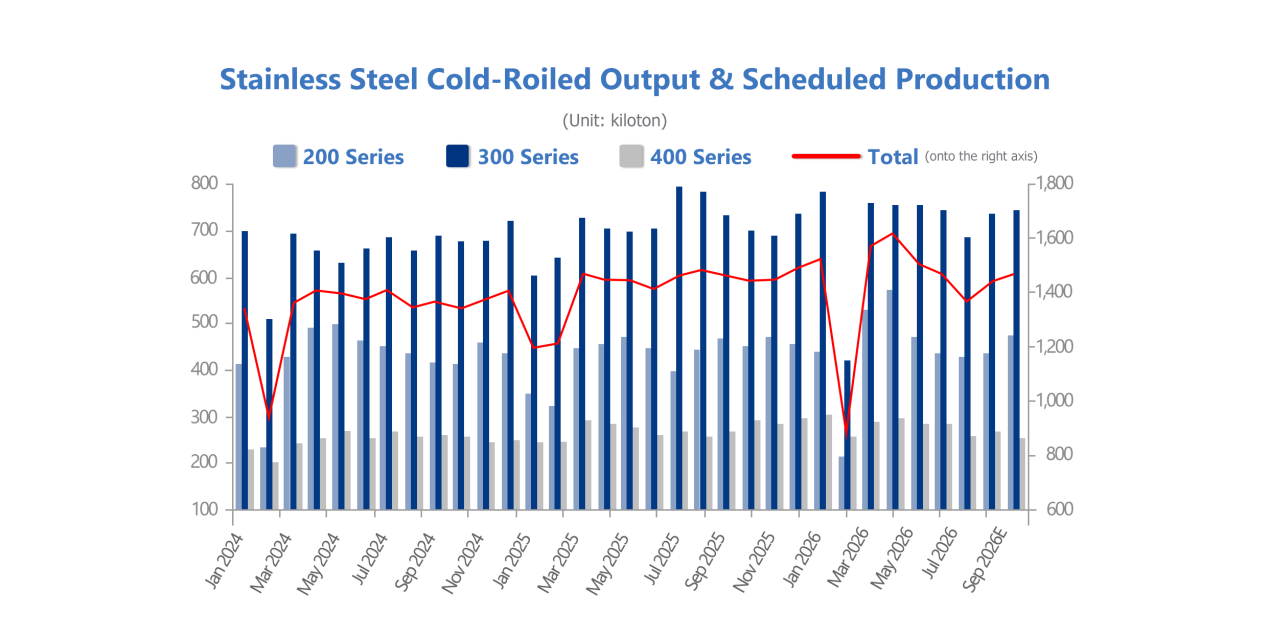

After some steel mills ended maintenance and production cuts in July, production resumed in August. Cold-rolled supply volume increased across all series, with the 300 series showing a clear rebound.
From January to August 2026, cumulative cold-rolled output from domestic stainless steel plants was about 11.4129 million tons, up 276,300 tons year-on-year, or 2.48%. Among them, 200-series volume was about 3.5349 million tons, up 192,900 tons year-on-year, or 5.77%; 300-series volume was about 5.6386 million tons, down 24,000 tons year-on-year, or 0.42%; and 400-series volume was about 2.2394 million tons, up 107,400 tons year-on-year, or 5.04%.
According to Mysteel research, the estimated cold-rolled production schedule of 41 domestic stainless steel plants for September 2026 is 1.4705 million tons, up 27,400 tons month-on-month, or 1.9%, and up 0.39% year-on-year.
- Stainless steel 200-series production scheduling is 476,000 tons, expected to increase by 38,800 tons month-on-month, or 8.87%, and by 2.04% year-on-year.
- Stainless steel 300-series production scheduling is 742,500 tons, expected to increase by 5,100 tons month-on-month, or 0.69%, and by 1.6% year-on-year.
- Stainless steel 400-series production scheduling is 252,000 tons, expected to decrease by 16,500 tons month-on-month, or 6.15%, and by 5.79% year-on-year.
Summary: September Peak Season, China's Stainless Steel Demand Shows No Improvement
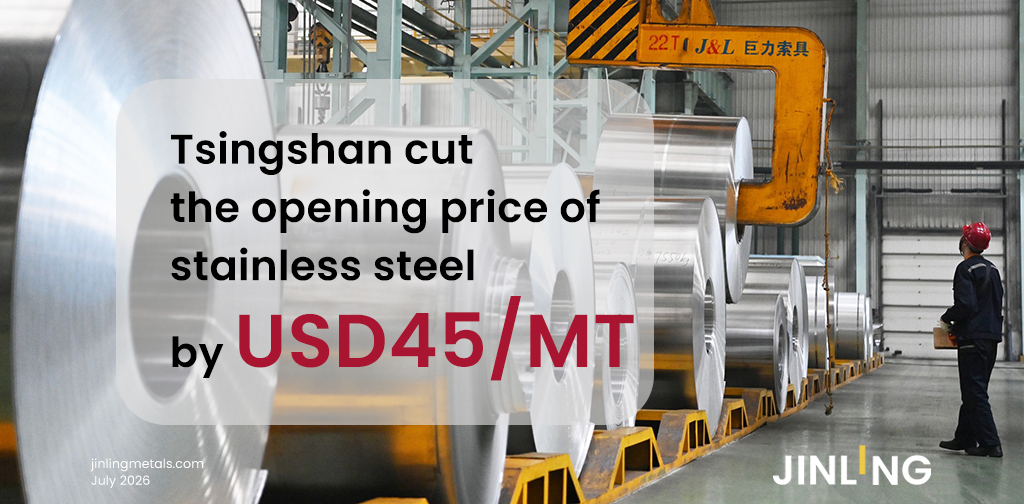
Last week, stainless steel 304 spot prices fluctuated weakly. Mid-week, Tsingshan opened flat plate allocations and floated the board price down by US$30/MT for shipments, significantly easing market panic. Wuxi stainless steel 300-series inventory destocked by 21,000 tons to 423,000 tons, and cold-rolled 5-foot material continued to face specification shortages.
On the cost side, high-grade ferronickel remained flat while ferrochrome retreated, shifting cost support downward. The market is now at a critical transition window between the off-season and the peak season. Future focus will be on steel mill destocking and the pace of terminal demand repair during Golden September. If demand falls short of expectations, prices may still face downward pressure and a secondary bottoming.
For 201, Wuxi spot prices operated weakly, with base prices for Hongwang, Desheng, and Beigang all lowered. Some resources once touched around US$1,250/MT, but low-level restocking by downstream buyers drove a marginal improvement in cold-rolled transactions. Stainless steel 200-series inventory decreased by 5,800 tons to 76,100 tons, with both cold- and hot-rolled inventory destocking synchronously.
Steel mills have production-cut plans for September, but social inventory remains high for the year, so supply pressure persists. Going forward, focus will be on production cut and maintenance trends. If transactions continue to improve, inventory is expected to re-enter a downward channel.
For 430, the market operated weakly and stably, with both cold- and hot-rolled quotations flat compared with the previous week. High-carbon ferrochrome stopped falling and stabilized, while 430 cold-rolled material still maintained a certain profit margin. Stainless steel 400-series inventory decreased by 2,900 tons to 139,400 tons, with both cold- and hot-rolled destocking, strengthening the destocking signal compared with the previous week.
September steel mill production scheduling retreated slightly, which is expected to ease arrival pressure. As downstream demand gradually enters the traditional consumption peak season, there are expectations for marginal terminal demand improvement. Future focus will be on the sustainability of destocking and the actual release strength of downstream demand.
Sea Freight: Cost Has Kept Rising in the China-America Routes
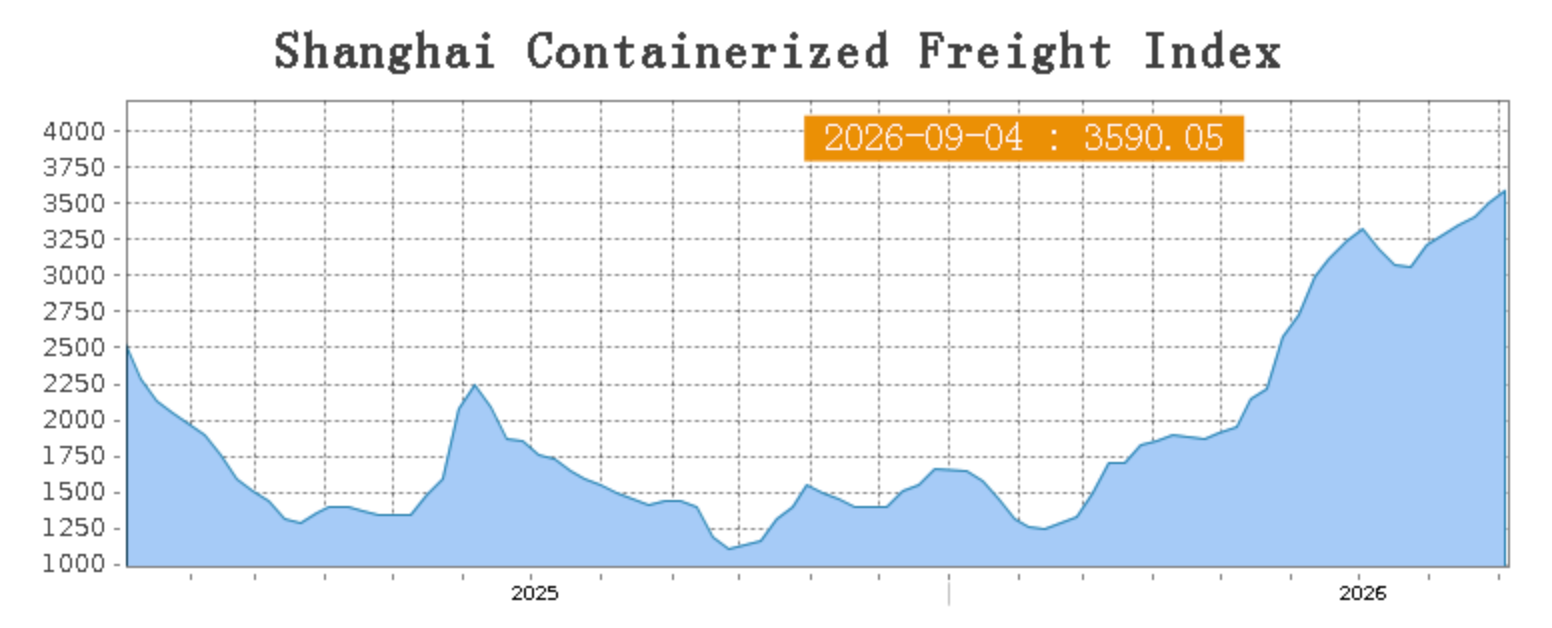
Last week, China's export container shipping market was generally stable, with divergent trends across different routes. According to the latest data released by the National Bureau of Statistics, on September 4, the Shanghai Containerized Freight Index was 3,590.05 points, up 2.3% from the previous period.
- European route: Shipping demand was basically stable, and market freight rates continued to fall. On September 4, the market freight rate, including ocean freight and surcharges, from Shanghai Port to European base ports was US$2,643/TEU, down 2.7% from the previous period.
- Mediterranean route: Supply-demand fundamentals appeared slightly weak, and spot market freight rates continued downward. On September 4, the market freight rate from Shanghai Port to Mediterranean base ports was US$3,442/TEU, down 3.2% from the previous period.
- North American route: Shipping demand remained high and supply-demand conditions were favorable, driving spot booking prices to continue upward. On September 4, freight rates from Shanghai Port to US West Coast and US East Coast base ports were US$7,242/FEU and US$10,324/FEU, up 4.4% and 2.8% respectively from the previous period.
- Persian Gulf route: A small-scale conflict erupted in the region, but the overall situation remained relatively stable. The container shipping market for this route still needs time to recover, and the freight rate index remained stable. On September 4, the market freight rate from Shanghai Port to Persian Gulf base ports was US$6,135/TEU, down 0.1% from the previous period.
- Australia-New Zealand route: Shipping demand performed well, supply-demand fundamentals were solid, and spot market freight rates continued to rise. On September 4, the market freight rate from Shanghai Port to Australia-New Zealand base ports was US$2,640/TEU, up 6.8% from the previous period.
- South American route: Shipping demand maintained steady growth, pushing market freight rates to continue rising. On September 4, the market freight rate from Shanghai Port to South American base ports was US$8,953/TEU, up 3.3% from the previous period.
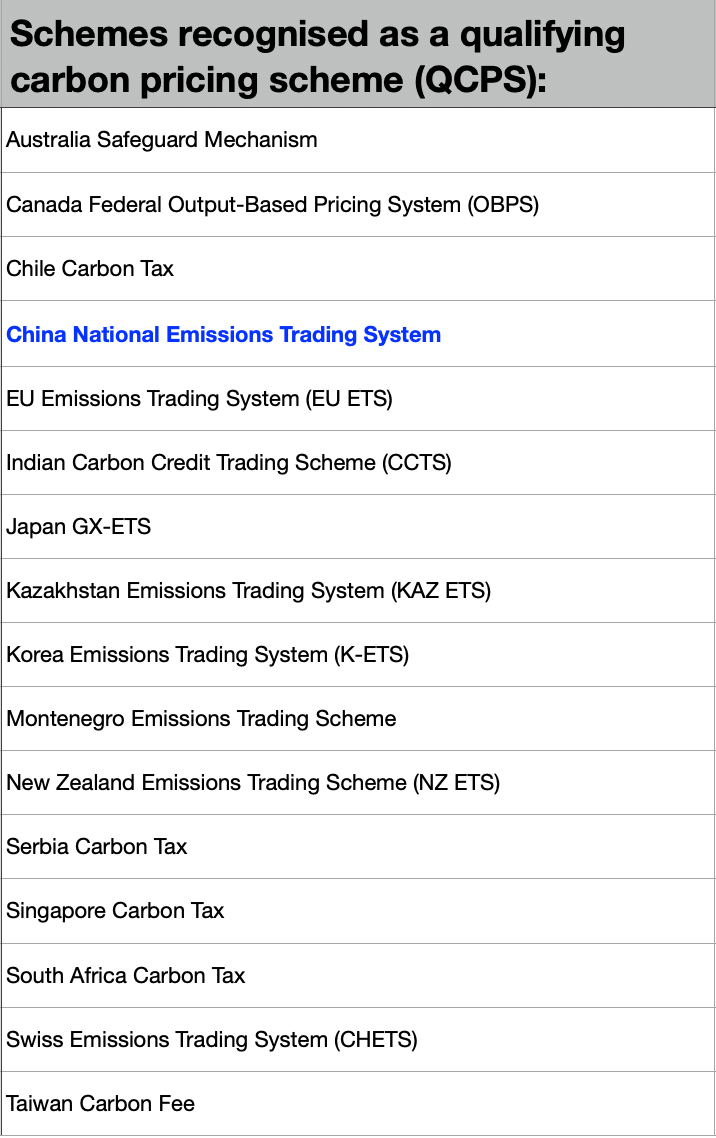
UK CBAM Recognizes China's Carbon Pricing Scheme
In the latest list published on August 27, 2026, the UK government officially designated the China National Emissions Trading System as a Qualifying Carbon Pricing Scheme under the UK CBAM framework.
This means that for CBAM-covered products such as steel exported from China to the UK, if the production process has already incurred a qualifying Chinese carbon price, UK importers can apply for corresponding Carbon Price Relief.
The most direct implication for UK buyers is a potential reduction in CBAM costs. The UK CBAM is set to take effect on January 1, 2027, covering products such as steel, aluminum, cement, fertilizers, and hydrogen. Importers will need to bear CBAM costs corresponding to the embedded carbon emissions of imported products.
This can be understood as:
UK CBAM carbon costs due - qualifying carbon costs already paid in China = final CBAM costs borne by the UK importer
With the UK government's recognition of the Chinese carbon market, UK buyers can avoid being charged twice for the same carbon emissions. The UK government has stated that Carbon Price Relief aims to prevent double charging where imported goods are subject to a levy in the UK after already incurring a qualifying carbon price in their country of origin.
Other carbon pricing schemes recognized as qualifying schemes under the UK CBAM framework include: